Hay: The Bunny Superfood

Hay is the primary source of food for your rabbit, it should be available all day for your rabbit. Rabbits are grazers and it’s normal for them to pick off their favorite parts of the hay and leave the rest behind. I like to say rabbits are foodies, they love new tastes, smells, and textures. I find the more variety of hay you offer them the less likely they will try to eat carpet fibers, clothing, papers, and wood.
At cuddly buns we send our babies off with a healthy appetite for hay for many reasons. It encourages proper dental tooth wear, good mastication(chewing) habits, reduces digestive diseases, proper development of mandible and maxillary bones (prevents dental issues in the future), reduces gas build up, speeds up gut motility, it gives a slow and steady growth rate, and it prevents obesity. Most breeders will raise their bunnies on pellet feed, because it is cheaper. A 40lb bag of rabbit feed costs $20, a 40lb box of hay costs $80, then you factor in how much hay a bunny wastes.
1Month – 4Months: We like to start our babies on timothy 3rd cutting hay, or orchard, the abundance soft green stems provide bunnies with a slow and steady growth rate. You can order them from these sites here. Very few vendors offer 3rd cutting. If you can’t get ahold of 3rd cutting you will need to monitor your bunnies growth more closely while on 2nd cutting.
4Months Plus: Now your bunny should be converted to timothy 2nd cutting. Not all 2nd cutting is created equally, you want to find a good balance of grass stalks and grass leaf in your box. A good balance is about 50stalks/50leafs.
** Alfalfa is not a hay it is a clover. It’s overly nutritious and delicious and rabbits will lick every crumb off the ground, but that doesn’t mean it is healthy for them. It is high in calcium, sugar and protein. High calcium may lead sludge bladder, the high sugar can lead to gi stasis(a deadly digestive disorder), enterotoxaemia(a deadly bowel disease) and obesity. However Alfalfa can be used as a daily treat, offer your bunny a small handful daily but we never recommend using it purely. Raising bunnies on alfalfa is a popular method to raising livestock rabbits. It is by no means the safest or healthiest way to raise your baby.
Hay Buyer’s Guide
** The greener the hay the more Vitamin D & nutrients are trapped in it, which is important to for rabbits who may not have access to direct sunlight. Hay sitting on the shelves for a long time will be more greenish yellow.
** Cheap hay tends to be dusty, these small particles tend to get lodged in tear ducts and nasal passes that may end requiring medical assistance to remove them. Avoid using the dust at the bottom of the bag.
** Not all hay is created equally many hay vendors offer customer satisfaction. Always check your hay for abnormalities like weeds and thorns. Shopping around for good hay is sometimes needed as your favorite hay vendor may sometimes have a very bad yield season to season, year to year.
** Orchard hay is a great alternative to those who have allergies to timothy hay. If you discover you have bad grass allergies clients may call me for advice.
** Timothy 1st cutting is great for over weight bunnies.
** Another popular hay is meadow hay, some bunnies love it!
** Oat hay should be used as is a sweet and crunchy treat and not a primary source of hay.
** Yard Grass! Fiscus, Brome, Crab Grass and many other yard grasses you find in your back yard is not only editable but it preferred by many rabbits and can help keep hay costs down in the warmer months. Just make sure the lawn is free of pesticides and weed killers. Avoid ornamental grasses.
Vegetables
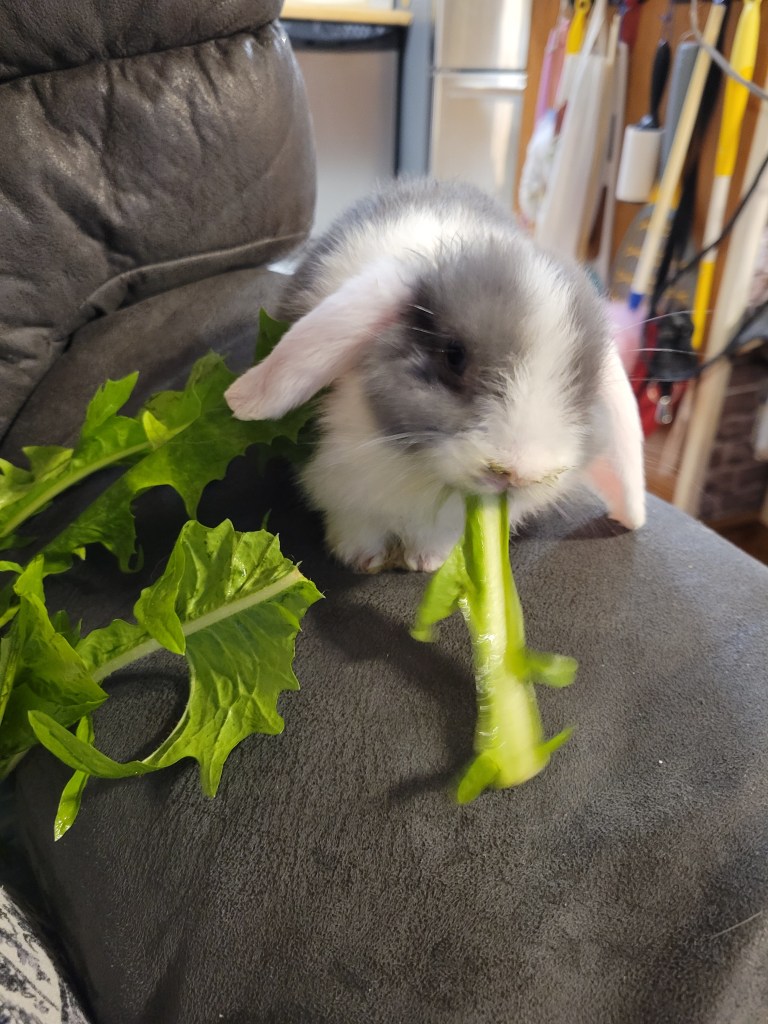
Vegetables are important, not only do they cover Essential Amino acids missing in some hays they add moisture back to the gut. Many herbs have the benefit of combating potentially dangerous gram negative bacteria. New vegetables should always be introduced slowly as the bodies micro flora adjusts to new sources of food.
I recommend that at least 1 cup of loose leafy greens be given to your baby bunny daily. Rotate the variety of fresh greens you give them weekly. Calcium and Vitamin D is vital in growing bunnies, a lack of calcium is far more dangerous than excess calcium in the range of 1-6 months. Keep in mind the majority of their daily calcium will come from their hay.
There are a few nutritional concepts we need to pay attention to when feeding our veggies,
Sugar: Sugar is also known as carbohydrates or starches. Starchy root vegetables are a big NO NO. Veggies high in sugar should be limited to twice a week. How do I know if my bunny has been eating to much sugar? Watch your bunnies fecal droppings, if the poop is getting soft, starting to stick to the fur and smell’s bad that means your bunny diet has to much sugar in it. If the stool progresses to diarrhea, this is a medical emergency. Generally the older your bunny gets the better they can handle their sugars.
Soluble Fiber: Soluble fibers are found in all plants its the spongy part of the plant that holds water. Stems tend to have the most soluble fiber. When your rabbit consumes large amounts of this fiber daily it eventually causes a gas build up leading to gi stasis. Cutting the stems off your leafy greens is a good way to cut back on the soluble fiber, otherwise limit high soluble foods to just twice a week.
Calcium: Avoid calcium rich veggies if your rabbit is over weight, lazy(as in they rarely run around), or has limited space to exercise, calcium can build up in in the bladder and cause a condition known as sludge bladder. Some research has linked calcium oxalates to the formation of stones in the bladder or kidney. Rabbits who live healthy active lifestyles do not need to worry about calcium intake.
| Plant | Sugar | Soluble Fiber | Calcium Per Cup |
| Kale** | Moderate – High | High in the Stems | High |
| Collard Greens | High | High in the Stems | Very High |
| Spinach | Low | Low | Calcium Oxalate |
| Carrot Tops | Moderate | Low | High |
| Swiss Chard | No | Low – High in the Stems | Calcium Oxalate |
| Beet Tops | Moderate | Low | Medium |
| Oregano | Low | Low | Low |
| Basil | Low | Low | Medium |
| Thyme | Low | Low | High |
| Turnip Top | Low | High In Stems | Very High |
| Mustard Greens | Moderate | Low – High in Stems | High |
| Bok Choy | High | Very High | Very High |
| Dandelion | Low – Moderate | Low | High |
| Fennel | High | High | High |
| Watercress | Low | Low | High |
| Celery | Moderate | Moderate | Low |
| Parsley | Low – Moderate | Low | Very High |
| Romaine | Low | Low | Low |
| Cucumber | Low | Moderate | Low |
| Lettuce Red & Green | Low | Low | Low |
| Cabbage** | High | Very High | High |
| Broccoli & Cauliflower ** | High | Very High | Medium |
| Brussel Sprouts ** | High | Very High | Medium |
*Notice how carrots and other starchy vegetables are not on this list. Starchy vegetables encourage the growth of gas building bacteria which can be life threatening.
** The Cole group of vegetables have been known to make some rabbits gassy. This includes Collard Greens, Kale, Cabbage, Brussel Sprouts and Broccoli.
*** Calcium oxalates are a type of non available type of calcium found in foods, while chard, beet tops may seem high in calcium they are not due to the type of calcium in them. Some studies link Calcium oxalate to the formation of bladder and kidney stone, proceed at your caution.
** A spring salad mix is an easy to get a good mixture of leafy greens to your bunny.
Pellets: Junkfood
Through my own research I have decided to leave commercialized pellets out of my rabbits’ diets. Over the last 20 years, pellet feed was designed to be so tasty that once your rabbit found their favorite food they refused to eat anything other than their favorite junk food.
Today many pellets are still filled with addictive additives such as black strap molasses, beet sugars, salt, alfalfa, and corn syrup then there are the more life threatening ingredients like soy hulls, pea shells, starches.
Many pellet feeds are full of industry by products, like the shells on grains of wheat, which they call wheat middling’s, soy hulls, pea shells, ect. Normally these foods are indigestible, so bacteria is used to break down these non editable food sources. During this process gases are produced.
Obesity, dental issues, and gastrointestinal stasis are the result of pellet feed. The average cost of a rabbit in GI Stasis (a life threatening condition) will run you $400.00-$1800.00 at an exotic specialist, blood work, subcutaneous fluids, 24hour care, x-rays it can get expensive fast. Yet the solution to the problem is, feed your rabbit less pellets.
The vitamins in pellets can’t replace feeding your rabbits vegetables.
Exception to No Pellet Rule
There is only one reason I would give my rabbits pellets, and that is if the rabbit is underweight. Some bunnies are just power houses of energy and they will lose weight faster than they gain weight. Even then I would choose a pellet made of pure of hay pure. I use them for lactating does who need the extra energy and calories to feed all those little mouths. The mechanical grinding process helps release the pectin and hemicellulose that’s normally protected within indigestible cell walls.
If you really want pellets to be a part of your bunnies diet I recommend Sherwood Brand of Pellets as they don’t use any cheap and dangerous fillers in their product.
Fruit
Bunnies are foodies they love fruit and just like us! There are studies that show the fructose in fruit can help keep bad bacteria in bunnies belly in check! However fruit also has sugar and soluble fiber in it. Here’s my rule with fruit keep serving sizes, keep it in perspective. If you give your baby 10 grapes, that’s like you eating 10 small watermelons. If you eat an apple its the size of your hand, so give them a piece of apple peel the size of their front paw. As your bunny gets older their ability to absorb sugar through the small intestine gets better, and their fruit consumption can increase.
 Cuddly Buns